
Engaged Buddhism
🕊️Impact #3: When the world is breaking, how do we respond without breaking ourselves?

Dictatorships are tightening control.
Corruption is becoming normalized.
Peace is suppressed. Justice is delayed. Democracy is weakened.
This is lived reality for millions of people right now—and it touches all of us, even when it feels far away. Every morning, we wake up to terrifying headlines.
Food prices rise.
Borders close.
Bombs drop.
Media manipulates fear.
Communities fracture.
Resentment spreads faster than truth.
Everything is interconnected. There is no “out there” that stays out there forever.
The Buddha did not teach withdrawal from reality. He taught clarity within reality.
Because when fear hijacks the nervous system, we react.
When anger dominates, we polarize.
When resentment takes over, we dehumanize.
This is why inner work is not separate from social action.
It is the foundation of it.
Still, a real question remains—especially for modern Buddhists, meditators, and mindful people:
If Buddhism is about inner peace, how do we respond to what’s happening out there?
Collective Suffering as a Korean
One of the most unexpected—and formative—lessons in my life arrived when I returned to my hometown elementary school in fifth grade.
I had attended that school in first grade, transferred away for three years, then returned. On my first day back, I ran into a close friend in the hallway. She welcomed me with open arms.
“Hey! You’re back! Do you remember Minsu from first grade?”
Of course I did.
Minsu was the tallest kid in class—a little chubby, kind. We were close. He walked me home almost every day. We talked about kids’ life—our worries and stress—parents, dreams, and the cartoons we liked. He used to say he wanted to become president when he grew up.
“Of course,” I said. “How is he? Which class is he in this year?”
Her next sentence hit me like a baseball bat—especially my heart.
“He died. During the IMF financial crisis, his father drugged the entire family and killed them all. But… Minsu really liked you. You were probably his first love.”
She rushed off to class.
I stood there, 11 years old, frozen in the hallway. My heart was racing. I could only feel one thing: sadness. Overwhelming sadness.
I pictured his family home—the place where we used to sit together, making instant noodles at the dining table. That dusty, blurry image has never left me.
The IMF financial crisis was brutal, I mean… bloody brutal.
Not only Minsu’s family, but countless families were destroyed overnight.
That was the moment I learned, in the hardest way, how money and systems can shake an entire nation—and collapse families into tragedy within just a few days, without bombs or weapons, without visible or tangible violence, without blood on hands.
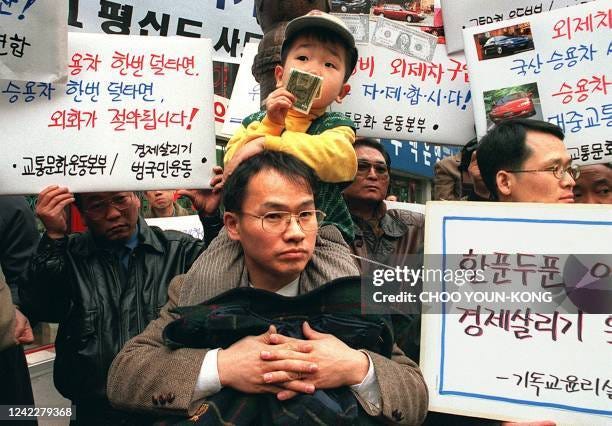
Koreans responded the only way we knew how: collectively.
We had survived Japanese colonization, war, division, and external governance by the U.S. and the Soviet Union. All of this happened less than 80 years. We rebuilt again and again.
To repay the IMF debt, households across the country voluntarily donated gold.
My mother emptied drawers and closets.
Her wedding rings.
My sister’s 100-day baby celebration rings.
Objects layered with memory, history, and identity.
But none of that mattered more than life itself.
If we did not overcome this crisis, more families would be destroyed. We, as a collective community, would not be able to live the way we used to anymore.
Gold meant nothing compared to that.
Historically and culturally, the Korean spirit has always been community-driven. Even Mahāyāna Buddhism*—with its vow to liberate all beings before oneself—felt organically aligned with this mindset.
And then there was my first great teacher.
*Mahayāna Buddhism emphasizes the Bodhisattva ideal: the aspiration to cultivate wisdom and compassion not only for one’s own liberation, but for the alleviation of suffering for all beings. Emerging around the first century BCE, Mahāyāna traditions stress interdependence (pratītyasamutpāda), emptiness (śūnyatā), and engaged compassion in everyday life, shaping Buddhist practice across East Asia, including Korea, China, and Japan.
Learning Engaged Buddhism from a Living Example
Ven. Pomnyun Sunim* shaped my ethics, leadership, and worldview profoundly.
He never separated Dharma from reality.
He never avoided global injustice.
Instead, he worked for decades in peace-building and reconciliation—Afghanistan, North Korea, India, the Philippines, Myanmar, Nepal, Sri Lanka, Cambodia, and beyond.
Through him, I learned something essential and life-changing:
It is possible to walk the Middle Way while engaging the world fully.
It is possible to work for peace without losing inner peace.
And it was necessary to be engaged in peace-building movements, voices, and social action at a certain level—as a global citizen and a young leader. It simply made sense to me to be part of social engagement in any form: petitions, voting, donations, business, consumption, campaigns, or even a social media post.
*Venerable Pomnyun Sunim is a Korean Buddhist monk and internationally recognized leader in engaged Buddhism, known for integrating Buddhist practice with humanitarian relief, peace-building, and social reform. He is the founder of Jungto Society (Join Together Society), a global grassroots movement focused on ethical living, education, environmental sustainability, and conflict reconciliation. Since the 1990s, he has been actively involved in humanitarian and peace initiatives, advocating nonviolent dialogue beyond ideological divisions. Pomnyun Sunim has received major international recognition for his work, including the Ramon Magsaysay Award (2002) and the Niwano Peace Prize (2020), honoring his lifelong commitment to peace, compassion, and socially engaged Buddhist leadership.
Engaged Buddhism Is Regulated Action
Anger, grief, outrage—these emotions make sense. They are human responses. But the real question is:
What happens when these emotions drive action?
The Buddha did not tell us to suppress emotion. He taught us not to be ruled by it.
Engaged Buddhism is rooted in Right Intention:
Non-harming
Compassion
Wisdom
It is not about:
Winning
Shaming
Moral superiority
Forcing reality to conform to our rage
We can protest and still dehumanize.
We can advocate and still reproduce violence.
We can speak truth and still poison the field with hatred.
So we must ask—again and again:
Does my action reduce suffering, or multiply it in another form?
Silence is not always neutral—but noise is not always action.
The Buddha was clear: You are responsible for your actions. You are not responsible for controlling outcomes.
Outcomes depend on countless conditions:
History
Power structures
Timing
Collective readiness
Forces we cannot see
So what can we do?
Act fully.
Care deeply.
Release the outcome.
We do not need to become monks.
We do not need to withdraw from society.
We do not need to shout all the time.
We need to:
Regulate our nervous systems
Clarify our intentions
Choose actions we can sustain
Stay human while resisting inhuman systems
Vote if you can.
Speak when it matters.
Protect who you can.
Support ethically.
Refuse dehumanization.
Rest when needed.
Return again.
Do what makes sense for you. Own the consequences of your choices.
Why the Bodhisattva Vow Is Infinite
The Bodhisattva vows to save all sentient beings before enlightenment. This vow is intentionally impossible. Not to discourage us—but to teach us that the vow is about sincerity, not completion.
Right action without right intention becomes idealism mixed with self-attachment.
It looks noble, but internally it turns into tension.
This is why so many activists, environmentalists, healers, and social entrepreneurs burn out. Not because the cause is wrong—but because the attachment is heavy.
The Buddha warned us:
“Craving leads to sorrow.
Craving leads to fear.”
— Dhammapada 216
Craving is not only for material things.
It includes:
Craving that society changes on my timeline
Craving that others awaken the way I want
Craving that justice must look like my vision
Even noble intentions become suffering when we cling to outcomes.
There will always be injustice.
There will always be suffering beings.
This is the nature of saṃsāra.
But your heart does not need to be consumed by it.
We work for change not because the world will perfectly respond—but because compassion is who we choose to be.
When intention aligns with the Dhamma, we don’t burn out.
We awaken.